
Signal 01
Unified intake
Bring in OMs, rent rolls, ARGUS, financials, broker assumptions, and support docs in one place.
Turn offering memorandums, rent rolls, ARGUS files, Excel models, broker assumptions, market benchmarks, and property tax data into a built underwriting model and IC-ready memo.
Reef gives real estate finance teams one governed operating layer for intake, underwriting, review, and committee output.
Why Reef
Instead of rebuilding every deal across PDFs, models, benchmarks, tax research, and memo drafts, Reef keeps the chain connected from the first upload through final approval.
Trusted workflow alignment
Used by acquisitions, asset management, investment, and capital markets teams that need faster underwriting, cleaner IC packages, and fewer decision bottlenecks.
Signal 01
Bring in OMs, rent rolls, ARGUS, financials, broker assumptions, and support docs in one place.
Signal 02
Generate the working model, enrich it with context, and keep revisions visible for the full team.
Signal 03
Draft the IC memo, proof the package, and move into review without losing traceability.
Quantified value
governed workspace
One source of truth for source files, model logic, review, and memo output.
workflow stages connected
Input through institutional memory, linked inside one operating system.
steps from upload to approval
A clear path from raw deal materials to a review-ready recommendation.
finance-critical capabilities
Extraction, modeling, benchmarking, flagging, proofing, memory, and more in one flow.
The Core Problem
Most teams still push live deals through a fragile production workflow that slows bids, burns analyst time, and weakens confidence by the time a package reaches committee.
What the old workflow creates
That means slower bids, more low-value analyst work, inconsistent decisions, and lower confidence at IC.
Where time gets lost
8 friction pointsOMs arrive with buried assumptions
Rent rolls and financials change format every time
Analysts rebuild models from scattered documents
Benchmarks live in separate tools and spreadsheets
Tax lookups require more research
IC memos start in disconnected writing tools
Inconsistencies get caught late
Prior deal logic is hard to reuse
Value Proposition
Reef carries a deal from raw intake to investment committee output. It does not stop at extraction, underwriting, or memo generation. It connects the full chain into one controlled system of record.
01
Input
02
Underwrite
03
Benchmark
04
Flag
05
Edit
06
Review
07
Approve
08
Remember
Decision Engine
The platform keeps the model, the benchmark context, the risk flags, and the IC memo synchronized so teams spend less time stitching and more time deciding.
Extraction feeds underwriting instead of living in a side workflow.
Benchmarks and tax context show up inside the model, not outside it.
Risk checks surface before the memo reaches leadership.
Version history and institutional memory stay attached to the deal.
Model Template Management
Analysts and firms can upload approved company underwriting templates for Reef AI to use when generating the Excel model. That keeps output aligned with how the team already underwrites instead of forcing a one-size-fits-all structure.
Use your own approved Excel templates as the model-generation starting point.
Map new deals into the right template without rebuilding the structure by hand.
Swap templates on past deals quickly when the team wants to compare or restate the model.
Preserve firm logic, naming conventions, tabs, and presentation standards across deals.
Template flexibility without workflow chaos
Reef gives teams a governed template layer, so model generation stays fast while each firm keeps control over how the final underwriting file should look and behave.
Capabilities
Upload OMs, Excel files, ARGUS runs, rent rolls, financials, assumptions, and support materials together.
Start from one intake workflow instead of scattered handoffs.
Use extracted deal information, firm assumptions, and enrichment to produce a structured working model.
Go from raw files to finance-ready output much faster.
Ground each deal with market benchmarks and property tax context for a more defensible baseline.
Model against market reality, not only sponsor narrative.
Catch tenant concentration, occupancy dependence, rent anomalies, and cross-document inconsistencies sooner.
Surface risk before committee questions appear.
Generate a first-pass memo, proof it for gaps, and adapt the output to firm standards before export.
Replace blank-page writing and last-minute formatting chaos.
Review side by side, preserve version history, and retain reusable decision logic across prior deals.
Every deal compounds judgment instead of recreating it.
See the Platform
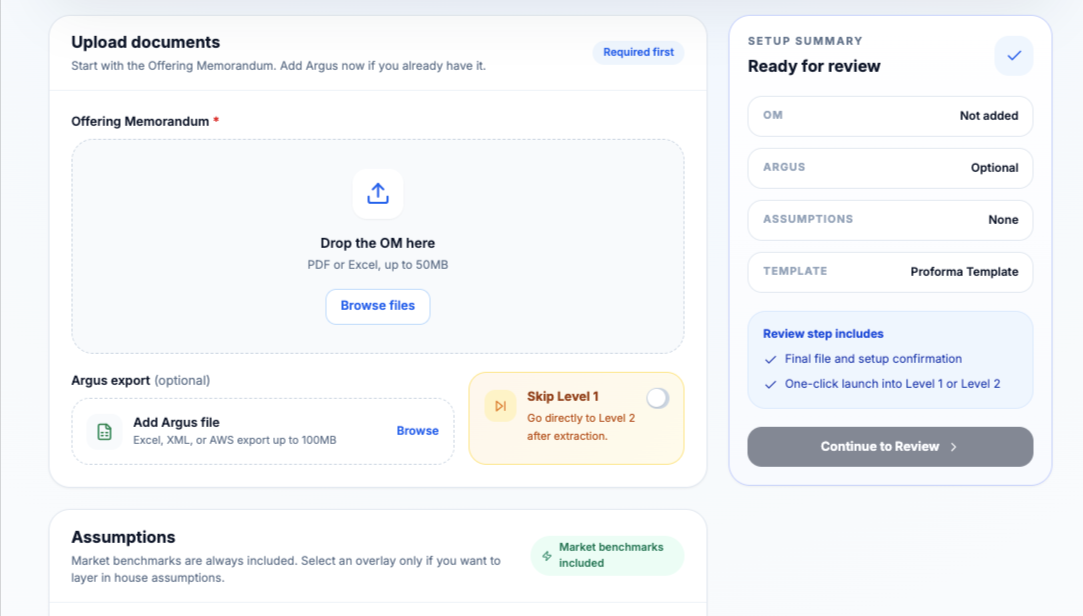
Screen 01 / 03
Streamline the process of creating and uploading new deals. Upload all necessary documents and materials in one unified interface.
How It Works
The workflow is linear for the deal team, but fully connected underneath. Each stage feeds the next without losing context.
Bring in the OM, ARGUS file, Excel files, rent roll, internal assumptions, and supporting documents.
Pull underwriting-relevant data from source materials into a usable decision framework.
Generate the live underwriting model and add market benchmarks plus property tax context.
Flag issues across the data, assumptions, outputs, and narrative before the package moves forward.
Create the first-pass committee package from the same source of truth behind the analysis.
Use focus mode, version control, and proofing tools to finalize the package before export.
Store the final deal, changes, assumptions, and memo as part of the firm’s memory layer.
Outcomes
Compress the time from deal receipt to first-pass underwriting and committee-ready materials.
Reduce low-value manual work so analysts can handle more deals without lowering quality.
Benchmark assumptions, catch inconsistencies, and surface risks earlier.
Give every team a consistent underwriting and IC workflow without rigid output.
Make prior deals, assumptions, and committee logic searchable and reusable.
Deliver cleaner, more defensible investment packages backed by traceable data.
Who It Is For
Move from OM intake to investment recommendation with less manual rebuilding.
Pressure-test assumptions and create consistent decision materials across the portfolio.
Review cleaner, more benchmarked, and more defensible materials with better traceability.
Standardize underwriting and IC workflows across teams, regions, and strategies.
Turn deal packages into structured risk analysis and committee-ready approvals faster.
Create repeatable investment workflows without fragmented spreadsheets and tribal knowledge.
Comparison
Manual OM review
Separate tax and market research
Rebuilt models from scratch
Memo creation in disconnected tools
Limited traceability across versions
Institutional knowledge buried in folders and inboxes
Unified intake across deal files
Automatic model generation
Embedded market and tax benchmarks
Risk flagging before committee review
Editable outputs with version control
IC memo creation from the same source of truth
Searchable memory across prior deals and decisions
Objection Handling
Reef is not designed to replace judgment. It is designed to remove the manual friction that keeps judgment from moving at the speed of opportunity.
It is not a generic chatbot attached to a file uploader and not another dashboard that leaves analysts doing the real work in spreadsheets late at night.
Institutional Memory
Most firms lose compounding value after each deal because the model, assumptions, memo, and reasoning end up in different places.
Reef turns each deal into reusable firm intelligence instead of a closed file.
Memory layer
Search prior deals and assumptions instantly
Memory layer
Compare current opportunities to historical decisions
Memory layer
Understand how assumptions changed over time
Memory layer
Identify recurring risk patterns
Memory layer
Reuse successful IC structures and argumentation
Memory layer
Answer investment questions with real internal precedent
Final CTA
If your team is still stitching together underwriting models, benchmark checks, tax research, and IC memos by hand, every decision process is more fragile than it needs to be.
Reef gives your team one system to move from raw deal materials to a committee-ready decision package with more speed, more consistency, and more confidence.
Underwrite faster. Defend decisions better. Build institutional intelligence with every deal.
FAQ
Everything you need to know about real estate underwriting software and the Underwrite-to-IC platform.
Real estate underwriting software automates the analysis of investment opportunities by extracting data from offering memorandums, rent rolls, and financial documents to generate valuation models, risk assessments, and investment committee memos.
While ARGUS focuses on cash flow modeling and Excel requires manual data entry, Reef automates the entire underwriting workflow—from document extraction through IC memo generation—in one connected platform.
An Underwrite-to-IC platform connects every step from receiving a deal (Underwrite) to presenting it for approval (Investment Committee). Instead of fragmented tools, teams get one system for deal intake, model generation, and IC presentation.
Investment committee software is used by real estate private equity firms, institutional acquisitions teams, asset managers, lenders, REITs, and family offices who regularly present deals to investment committees.
Reef reduces IC memo production from weeks to days. Once deal materials are uploaded, the platform extracts data, builds the underwriting model, and generates a first-draft IC memo within hours—achieving 70% time savings.
Yes. Upload your firm's standard Excel underwriting models—multifamily, office, industrial, or retail. The platform learns your template structure and generates all future underwrites within your existing framework.
Reef ingests offering memorandums (PDF), ARGUS exports, Excel models, rent rolls (CSV/XLSX), broker financials, and supporting documents. All deal materials enter through a unified intake workflow.
Every deal, assumption, and IC decision is stored in a searchable knowledge graph. Teams can instantly find comparable deals, track market assumption changes, and reuse successful IC structures across new opportunities.